Making and Maturing

Disciples of Jesus

  • Billy Graham and Conversion

    The time is fulfilled, and the kingdom of God has come near. Repent and believe the good news!

    -Mark 1:15

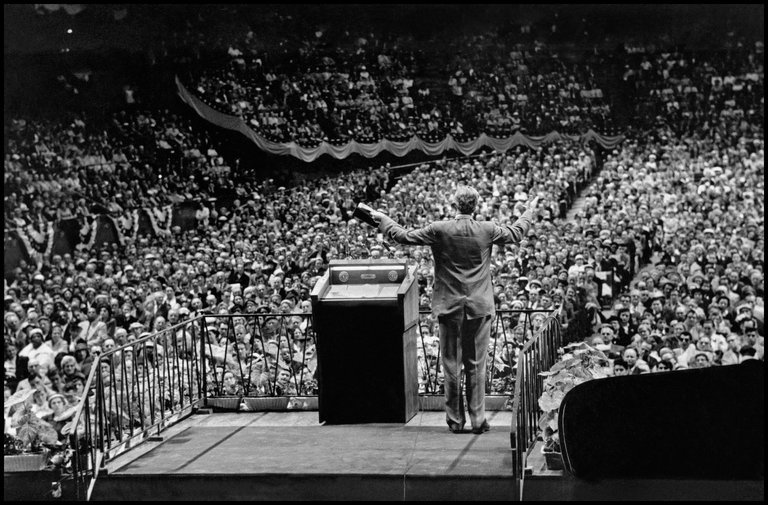
    Today we mourn the temporary loss of the great evangelist Billy Graham. God was glorified through his ministry, which saw an unusual blessing in a remarkable number of conversions.

    By “conversion” I don’t mean converting from one religion to another. Here “conversion” means a person repenting of their sin and believing in Jesus Christ for salvation. Countless people did just that after being encouraged to do so by Billy Graham in a sermon.

    In conversion, the Spirit of God must be at work, regenerating a person if they will truly repent and believe. The normal way the Spirit works is to use the preaching of the gospel and the call to respond:

    How, then, can they call on him they have not believed in? And how can they believe without hearing about him? And how can they hear without a preacher?

    -Rom 10:14

    Perhaps the reason why Billy Graham stands out is because calls for conversion have become rare. The reasons why should concern us.

    Pluralism Reigns

    In a culture where most people believe that every religion is equally true, calling for someone to repent and believe the gospel doesn’t compute. Why insist on change? Isn’t it arrogant to think that Christians have the only message of salvation? So pulpiteers have quietly adjusted. Calls for conversion have been relegated to personal conversation, if they happen at all. People in the pew have lost their taste for a direct call to respond to the good news by faith.

    Invitation or Manipulation?

    Many people who grew up in evangelical, especially baptist, churches experienced the never ending altar call where the pastor stubbornly leads the congregation in singing as many verses as “Just As I Am” as it takes until sometime will yield and mercifully come down the aisle. It felt like sheer manipulation because often it was.

    But should we throw out the baby with the bathwater? In an overreaction to manipulative attempts to grow church numbers, many have stopped calling people to respond to the gospel at all. The main problem with this is Jesus called people to respond (Mark 1:15) Paul and John called people to respond (Acts 2:38), and throughout church history preachers of the gospel have /invited/ people to respond by faith.

    People Don’t Believe in Hell

    They just don’t. They don’t believe in a God who would judge sinners. They don’t believe in sin except in extreme cases. So why attend a church where such topics are regularly expressed?

    Do we believe in hell? I recall an episode of Seinfeld that satirically dealt with this very issue. The character Elaine was dating a Christian who refused to share the gospel with her and she was irritated about it. Didn’t he care that she was destined for hell?
    One of the greatest gifts of Billy Graham was his genuine love for the lost. As he preached, he had passion. Why? Because he knew hell is real and people need to be convinced and convicted.

    Should Conversion Be Rare?

    Everyone is blown away at the way God used Billy Graham. Rightly so. But I wonder if we preached the gospel more and called for a response more if we wouldn’t see God save more sinners right before our eyes.

    We can’t force people to repent. No one will believe unless God brings them to life. But we know that the regular means of God saving sinners is to use the preaching of the gospel.

    By the end of Billy Graham’s life, what he is best known for is now seen as passé. As we look back, we can see his success wasn’t about him at all. It was God who blessed his preaching with such great fruit. As Jonathan Edwards said, remarking on the First Great Awakening,

    Indeed God has not taken that course, nor made use of those means, to begin and carry on this great work, which men in their wisdom would have thought most advisable, if he had asked their counsel; but quite the contrary. But it appears to me that the great God has wrought like himself, in the manner of his carrying on this work; so as very much to show his own glory, exalt his own sovereignty, power, and all-sufficiency. He has poured contempt on all that human strength, wisdom, prudence, and sufficiency which men have been wont to trust, and to glory in; so as greatly to cross, rebuke, and chastise the pride and other corruptions of men.

    May we reject the counsel of men, and continue preaching the gospel and calling for people to repent and believe. Just like Billy Graham.

  • Violence & the Second Sin

    Cain said to his brother Abel, “Let’s go out to the field.” And while they were in the field, Cain attacked his brother Abel and killed him.
    -Genesis 4:8

    It happened again. Another troubled young man. Another school. Another hour of terror. Another heartbreaking loss.

    Our culture is scrambling for answers. Again. Is tighter gun control the answer? Is better mental health analysis and treatment the answer? Is a renovated public school and educational system the answer? And on and on we go.

    Christians in our culture are in a tough spot. While we all should be considering practical ways to prevent people from killing each other (check out Romans 13:1-4), we know that none of these is the answer. Why? Because we know what the problem is. Sin.

    At this point you might roll your eyes and think, “We don’t need Sunday school answers. We need real solutions.” While I agree with the latter, if we really want to solve the problem, we have to know the cause. Access to guns didn’t cause these murders. Poor education didn’t cause these murders. Inadequate psychiatric care didn’t cause these murders. Failed investigating didn’t cause these murders. It was sin—rebellion against God and his law.

    It’s not a coincidence that the second wrong recorded for us in the Bible is an act of violence. The first was Adam and Eve’s tragic choice to disobey God and eat the forbidden fruit. That one seemed harmless enough, but it led to the second. Cain was angry that God accepted Abel’s offering and not his. God took the time to speak to Cain about his anger, correcting him. In Genesis 4:6-7 God asks Cain why he is furious. He instructs him to do what is right and beware of sin and temptation.

    It was after God spoke to Cain that he killed his brother. He thought, “I’m not the problem. Abel is.” Or, “I hate Abel.” Or, “I hate God.” Or all of the above. We don’t know. One way or another, in direct rebellion against God, and in an act of violence against his family and community, Cain murdered his brother.

    Fast forward to today and we have bigger weapons with greater capacity for harm, a failing public educational system, faulty concepts of mental health, investigative failures, and more. These are problems that need to be addressed. But they aren’t the problem. The problem is still rebellion against God.

    And the solution is submission to God by repentance over sin and faith in Jesus Christ. Imagine—if every person lived in real time submission to Jesus these problems would cease to exist. Jesus calls us not only to not murder, but to not even hate others. Imagine if we lived by that standard.

    These wrongs will be dealt with. When Jesus returns, he will judge the world. No one will have gotten away with anything. Only then will the New Jerusalem descend to earth, bringing with her eternal peace: no sin, and therefore no sickness, suffering, or death. That’s what our culture is clamoring for, and there’s only one way to get it.

    In the meantime what can we do? We mourn. We improve laws. We address public safety as best we can. But most importantly, we must preach the gospel and call people to repent of their sins and put their faith in Jesus who died and rose from the dead to save us from our rebellion against God.

  • Reclaim Your Time
    Pay careful attention, then, to how you live—not as unwise people but as wise— making the most of the time, because the days are evil.

    —Ephesians 5:15-16

    Every day we make decisions about what to prioritize.  To be fair, it’s a constant challenge to pause in the busyness of our lives and reflect on what we are valuing in our time.  I get it.  My family produces and never-ending mountain of laundry, dirty dishes, and piles of whatever.  Never mind paying bills, taking care of the yard, and fighting for some down time.
    Here’s the problem.  If we don’t stop and consider how we are using our days and hours, we will waste some of them.  Maybe most of them.  When Paul says we should make the most of our time because the days are evil, he means that the inertia of life isn’t God-centered.
    We need to reclaim the lost art of stewarding our time.  I mean sitting down with your spouse and/or family and talking about what matters most for your days.  When you have this conversation, you will be tempted to immediately focus on money, school, work, sports, vacations, etc.  Before you do, stop, pray, and consider what matters most: how will you make God and his kingdom your priority this year?
    Jesus recognizes the temptation to jump straight to needs.  This is why he helps us prioritize in Matthew 6:33,
    But seek first the kingdom of God and his righteousness, and all these things will be provided for you.
    Here are 4 suggested ways you can keep what matters most in the center of your life this year:

    1. Prioritize church attendance

    We all have to miss a few Sundays here and there, but there is no substitute for weekly corporate worship and fellowship with the church body.

    2. Prioritize Bible reading as a family

    Make a plan.  Download a devotional guide or an app.  Use the Abide Reading Plan.  Follow your church’s sermon schedule.  Whatever.  Do it.

    3. Prioritize deepening spiritual friendships in the church

    This is where a small group or Bible study or one on one discipleship meeting comes into play.  We have to set aside time for this, and work to protect it.  This is usually the first to go.

    4. Prioritize important events in your church

    I’m talking about ministry commitments, member meetings, big conferences or outreach events, work days, etc.
    What if we put the body of Christ first in how we structure our weekly schedules?  Our vacation schedules?  Our social calendars?  How often do we say no to the body of Christ and yes to something… else?
    This idea only sounds radical because our culture’s gravity is constantly pulling us out of orbit around God and his glory.  Don’t make it weird, make it normal.  #hiskingdomfirst
  • We Really Need This Christmas

    So, it’s been a rough year. Maybe not in actuality worse than others, but as a nation, we are reeling. Our news feeds have been filled with constant crises- conflict between ethnic groups, an embattled and shocking election, a string of deadly and destructive hurricanes, an avalanche of high profile sexual assault accusations, more embattled elections, and the list goes on.

    Beyond national woes, we all face the daily realities of living in a world broken by sin. Sickness and death invade our communities and families. Job losses, relational conflict, and financial difficulties stress us out. Indeed, we hear the Christmas bells, but agree with Longfellow,

    And in despair I bowed my head;

    “There is no peace on earth,” I said;

    “For hate is strong, and mocks the song

    Of peace on earth, good-will to men!”

    As challenging as this may be, it’s reason all the more to pause to remember the birth of Jesus, the Messiah. As Isaiah foretold in Isaiah 9:6-7,

    “For a child will be born for us, a son will be given to us, and the government will be on his shoulders. He will be named Wonderful Counselor, Mighty God, Eternal Father, Prince of Peace. The dominion will be vast, and its prosperity will never end. He will reign on the throne of David and over his kingdom, to establish and sustain it with justice and righteousness from now on and forever. The zeal of the LORD of Armies will accomplish this.”

    In this prophecy Isaiah focuses on who this child is, what he will do, and what drives him.

    Who He Is

    He is the Wonderful Counselor, which is a reference to a war counselor. He’s not a therapist, he’s the one who knows the right strategy for dealing with sin. He is Mighty God, which means we need never pin our hopes to a mere man. Here we see the mystery of the incarnation: a child born who is Mighty God. Third, he is the Eternal Father—the provider for and protector of his people. Finally, he is the Prince of Peace—the prince who brings about peace through his victory.

    What He Will Do

    After considering the identity of the child born, Isaiah focuses our eyes on what he will do—namely, set up the eternal kingdom of God. His kingdom “will be vast,” and its glory will never end. It’s David’s kingdom, fulfilling other promises God made in 2 Samuel 7:12-13. This links the child born to the string of promises God made to Abraham and his descendants. He will maintain this kingdom in absolute righteousness. Don’t miss this part—no more corrupt, abusive leaders. No more biased courts. No more mourning victims, just justice.

    What Drives Him

    How can we be sure this child will do this? How can we be sure his mission will be successful? Because “The zeal of the LORD of Armies” will get it done. This is God’s passion, to rescue sinners and restore the world to being very good. It is not a human scheme, or some corporation’s long term plan. The work of this child born to us is the work of God himself. This kingdom cannot be stopped.

    So Jesus was born. He became an adult. He was baptized and taught God’s Word and healed the sick. Finally, he achieved victory through humbling himself to death, even death on a cross in our place. He rose from the dead, conquering sin and death, and has now tasked us to preach the good news that his kingdom is here and growing.

    Yeah, it’s bad out there. It’s bad in here, too. But the Christmas bells are ringing. Once again we can say with Longfellow,

    Then pealed the bells more loud and deep:

    “God is not dead, nor doth He sleep;

    The Wrong shall fail, The Right prevail,

    With peace on earth, good-will to men.”

  • Does God Need the Pope’s Protection?

    Pope Francis has suggested revising the statement in the Lord’s Prayer from Matthew 6:13 from “lead us not into temptation,” to “do not let us fall into temptation.”

    This is exactly what French Roman Catholics have recently decided to do, changing the wording from et ne nous soumets pas à la tentation (“and subject us not to temptation”) to et ne nous laisse pas entrer en tentation (“and let us not enter into temptation”). These are all renderings of the Latin et ne nos inducas in tentationem, which is a rendering of the Greek text of Matthew 6:13 and Luke 11:4, καὶ μὴ εἰσενέγκῃς ἡμᾶς εἰς πειρασμόν.

    The thinking behind the change is that the wording is misleading, suggesting that when we are tempted, God has led us into that circumstance. This suggested change is significant both from a grammatical and theological perspective.

    Is the Pope Suggesting Editing the Word of God?

    From a grammatical perspective, the Greek text of the Lord’s prayer is unambiguous. Jesus models prayer for us, making a request to God the Father, that he would not “bring us into” or “expose us to” (Greek, εἰσφέρω) temptation, but instead, that he would deliver us from the Evil One (traditionally, “evil”). The Latin verb induco means essentially the same thing, “to lead into.”

    In this ask, Jesus presupposes that sometimes the Father ordains for us to be exposed to temptation, but that it is good for us ask God to protect us from temptation. More on this below.

    Grammatically, what the French have done, and what Pope Francis agrees with, is changing the verb from the idea of “causing us to enter” to “allow to fall/enter.” In the former, God the Father is unambiguously sovereign over the circumstances of temptation, while in the latter, he is simply observing us trip up. Francis said as much in a televised interview, speaking of God leading us into temptation, “A father doesn’t do that. He helps you get up right away. What induces into temptation is Satan.”

    But the Spirit of God did not inspire Matthew and Luke to write do not let us “fall into” temptation. God is definitely not the cause of our sin, but wrestling with a clear theology of temptation should never lead us to edit the Word of God. Editing the Roman Missal would, in effect, change the way Italian Roman Catholics memorize this part of God’s Word.

    Who Knows Better than God?

    The root of the issue isn’t grammatical, it’s theological. The Pope and other Roman Catholics aren’t comfortable with God being sovereign over temptation. The problem here is twofold, first the Bible clearly teaches that God is sovereign over temptation (James 1:2-4), but he is not the cause of it. Second, if God isn’t sovereign over temptation, then who is?

    The concern of the Pope and the French Catholics is that people think the prayer says that God intentionally leads people into circumstances where they will be tempted. People think that because that’s what the prayer request assumes. The premier example of this is in the ministry of Jesus when the Spirit leads him into the wilderness to be tempted by Satan: “Then Jesus was led into the wilderness by the Spirit to be tempted by the Devil” (Matthew 4:1, my translation, different verb than in Matthew 6:13). Satan is the primary agent of the temptation, but God is sovereign over it.

    Here’s the tough truth: sometimes God ordains difficult circumstances and trials to help us grow in our faith. While we need not desire difficulties, trials, and temptations (see the Lord’s Prayer), we should trust our sovereign God in the midst of them (cf. Genesis 50:20, James 1:2-4, 1 Peter 1:6-7, Romans 5:3-5).

    A Better Solution

    Rather than edit the Word of God, a better solution is a church that teaches the Word of God in its entirety, and has a robust Biblical theology of God’s sovereignty, sin, and temptation. It’s hard to effectively shepherd people through the mere recitation of verses. God has given us his Word that we might understand it, which means we need to work hard to explain it.

    Perhaps we could learn here from the Apostle Paul in 2 Corinthians 4:2, “but we have renounced the secrecy of shameful ways, not acting deceitfully, nor distorting the Word of God.”

    Rather than editing the Word of God to suit our theological ignorance, the church must let the Word of God form and shape our theology.