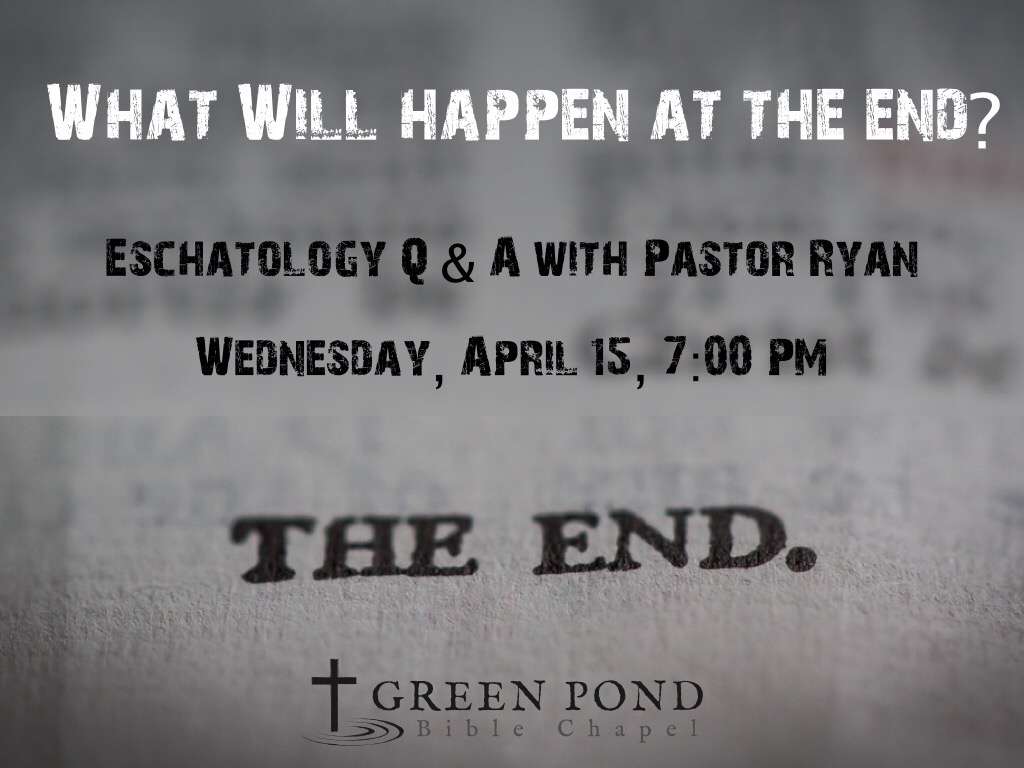
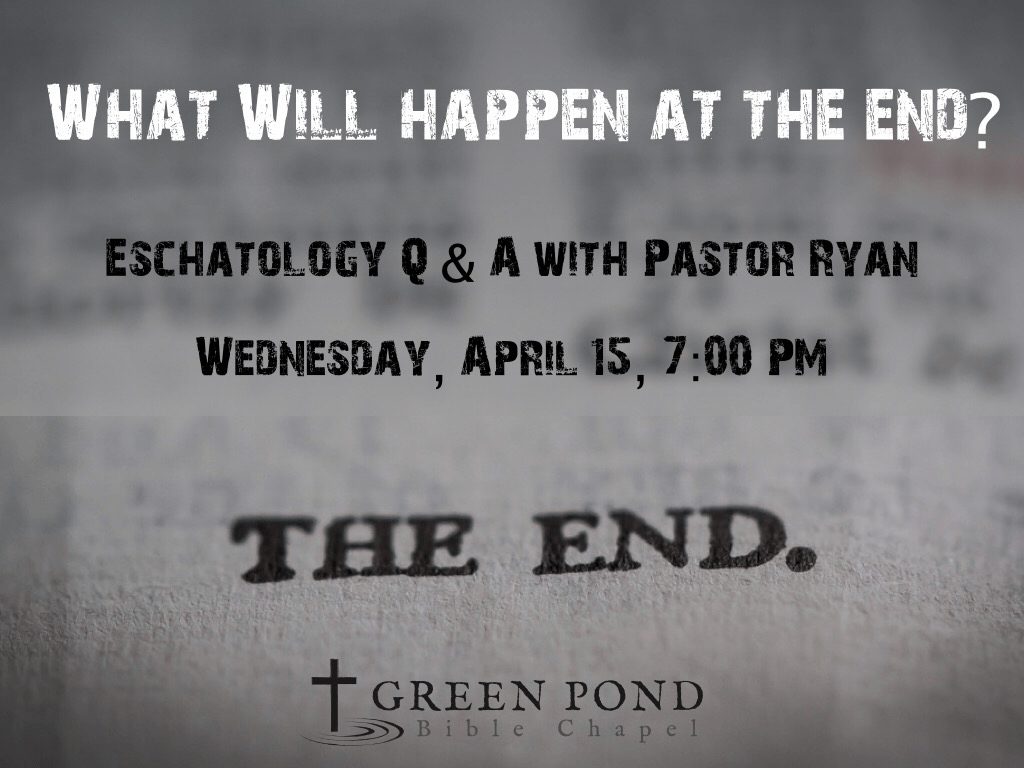
 Don’t forget to join us tonight at 7PM at GPBC for our “What Will Happen at the End” event. We will briefly explain some of the main Christian approaches to understanding the end times, and have a time of question and answer. Come, Lord Jesus!
Making and Maturing
Disciples of Jesus
-
-

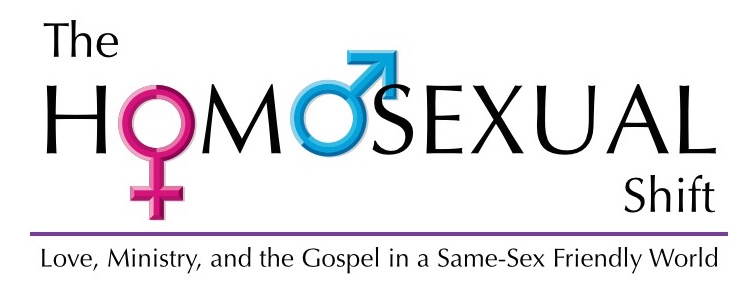
Homosexuality has become the issue of our time. Whether or not you’ve followed current events (like the recent developments in the Presbyterian Church in the USA, or the Indiana law on relgious freedom), we have all felt the ground shake as views on homosexuality have shifted in our culture with lightning speed.
The Homosexual Shift in the Church
It’s not remarkable that our culture has shifted. Cultures are always changing. What’s remarkable is where our culture has shifted. This shift has largely happened within Christianity. For the first time in the history of the New Testament church, there are now some who would identify themselves as Christians who teach that homosexual acts and desires are not sinful. The term “gay Christian” is now a part of our cultural landscape.
The Theological Shift
Those who take the Bible seriously might ask, “Don’t passages like Romans 1:26-27 settle the matter?” Fifty years ago, sure. But today some Christians teach that the parts of the Bible that talk about the sinfulness of homosexual acts and desires have been misunderstood. These new voices assert that, when read correctly, these passages actually teach that a homosexual couple in a monogamous marriage relationship is God honoring. This is a shift in how we interpret the Bible (hermeneutics), and it has enormous implications.
What was assumed for the last 2,000 years must now be proven. Does the Bible teach that homosexual acts are sinful? Does the Bible teach that homosexual desires are sinful? To what degree are we responsible for our sexual desires? What does it look like for someone to be a follower of Jesus and struggle with same-sex desires? We need to answer these questions with clarity.
The Personal Shift
But this isn’t just a theological debate. At the end of the day, we’re talking about people. Whether inside or outside of the church, people are struggling to make sense of their desires. Our children are growing up in an environment where they are often told that their desires are not wrong, no matter what they are.
Honestly, the lack of compassionate outreach to people who struggle with homosexual desires from the church has hindered our ability to respond. We’re fooling ourselves if we think people can’t tell whether or not they’re loved, whatever their struggles may be. Because of picket signs, conservative evangelical churches have a minimal voice into the homosexual community. This may not be accurate or fair, but it is the reality on the ground. How do we love and minister to people with homosexual desires and lifestyles?
So What?
Whether theologically or personally, our culture has shifted. We need to articulate our understanding of the Biblical passages that deal with homosexuality. But we can’t stop there. We need to consider how we can best make and mature disciples of Jesus in a same-sex friendly world. In the coming months at GPBC you’ll see four ways that we hope to respond to the homosexual shift in our culture:
- Starting June 3, we will host a Wednesday night summer series entitled The Homosexual Shift: Love, Ministry, and the Gospel in a Same Sex Friendly World. Come, ask questions, and gain insight into the Biblical teaching on homosexuality and current trends in our culture and in Christianity regarding homosexuality.
- Our elders are working on a position paper on the Biblical teaching on homosexuality and on how we are called by God to minister to to unbelieving homosexuals and believers who struggle with homosexual desires. This position paper may also result in a proposed addition to our church doctrinal statement. Some of our pastors will be attending conferences that deal with different aspects of ministering to homosexuals. Pray for our elders and pastors as they seek to address new approaches, and communicate our position as a church.
- Due to legal challenges surrounding this issue, our elders are also considering clarifying our policies and procedures regarding weddings and pastoral staff serving as wedding officiants. Pray for wisdom as we seek to navigate the legal implications of holding to a Biblical perspective on homosexuality.
- We are planning a short Sunday morning sermon series on homosexuality in January of 2016. Pray that we would grow in our ability to minister the gospel to unbelieving homosexuals and believers who struggle with homosexual desires.
-

Starting next week I have the privilege of being involved in the New Jersey Bible Institute (NJBI) for the first time. I will be teaching an Old Testament survey seminar. I am very excited to be a part of this ministry, and to see how God will use it to strengthen beleivers in northern New Jersey.
The purpose of the NJBI is “to offer seminars in biblical studies for those who desire to learn for their own edification. It also serves to instruct church educators, including pastors, teachers, elders, deacons, and youth pastors.” One of the blessings of the NJBI is the provision of a more formal learning environment than is available to the average church goer.
The OT Survey course I will be teaching is exciting because the majority of the OT is unexplored territory for most Christians. The Old Testament makes up two thirds of the Word of God, and covers vast chunks of history. Understanding the historical, cultural, and theological environment of the Old Testament is crucial to understanding the ministry of Jesus and the New Testament. This seminar is specifically designed to provide an overview of the Old Testament in an easy to remember format. If you take the class, you will master the general contents and chronology of the OT.
Registration for OT Survey closes Wednesday!
Please pray with me that the NJBI will be used by God to complement and strengthen local churches in northern New Jersey.
For whatever was written in former days was written for our instruction, that through endurance and through the encouragement of the Scriptures we might have hope.
-Romans 15:4
-

There is a river whose streams make glad the city of God, the holy habitation of the Most High.
-Psalm 46:4
I’ve often wondered about this river “whose streams make glad the city of God.” For years I had assumed that it was a metaphor for God’s provision and blessing. After all, the garden in Eden was situated between two rivers; Ezekiel’s vision of the new Jerusalem highlights a river flowing from the Temple, renewing the land of Israel; Revelation 22:1-2 describes a river of life flowing from the throne of the Father and the Lamb. Rivers are life giving, and God gives spiritual life to believers. On the surface, it seems like a happy-day metaphor. But this river is deep.
When we look closer at Psalm 46, a different image emerges. Psalm 46 is a famous Psalm due to verse 1, “God is our refuge and strength, a very present help in trouble.” It’s theme is clear: God’s people are safe in him. Thanks to Martin Luther, we are well acquainted with this truth. A mighty fortress is our God, indeed.
Verses 2-3 describe a chaotic “natural” disaster- if the earth gives way, the mountains fall into the sea, and the sea rages, we will not fear. At this point we need to pause and consider what the sons of Korah are really saying. We shouldn’t fear earthquakes, volcanoes, hurricanes, tsunamis, and raging oceans? These chaotic forces are exactly what we fear.
So what do these disasters represent in the Psalm? We get some help from verse 6- the nations are in an uproar due to the voice of the Lord bringing judgment upon them. The disasters are God’s judgment against the nations. His voice is melting the earth.
Then comes the river. Contextually, the river is linked to the raging sea of verse 3. In Hebrew, this verse literally just reads “A river, its streams…” The connection to verse 4 is obvious: the raging sea has resulted in a river headed for Jerusalem. The translators of the ancient Greek version of the Old Testament understood it this way, and translated this as a “violent river.”
Unfortunately, most English translations indicate that this river is unrelated to verses 2-3 by adding “there is.” I think verse 4 should read “This river” or “The river” (NET), rather than “There is a river” (ESV, NASB, NCSB, KJV).
What is clear in the Psalm is the idea of contrast. The Good News Version makes this explicit and suggests two rivers, “Yet there is a river…” But the contrast involved isn’t two different raging rivers, it’s two different responses to the same river.
Believers need not fear the judgment of God. The same waters that are disastrous to “the nations” bring joy to the city of God. There is the contrast. Unbelievers will fear God’s judgment, while believers will rejoice in the safety of God’s provision.
Verse 5 clarifies the sense: in the midst of the disaster, God’s city will not be moved. His purposes and his people are indestructible. In verse 6 he will judge the nations, but in verse 7 he is with us.
The concluding section of the Psalm calls us to look at the destruction of God’s judgment. Having appreciated God’s power in judgment, we should be still in awe and be confident in God’s existence, sovereignty, and purpose. Finally, we can take comfort because he is with us, and he is indeed our fortress. So let the river flow.
This Psalm may look forward to the final judgment. At that time, believers need not fear the judgment of God. In fact, we will rejoice as God rights all wrongs and finally brings sin and evil to its necessary end. This powerful reality brings to light three crucial truths for us today:
- God’s judgment is fear-inducing. Because of sin, humanity has more reason to fear God’s judgment than any other threat. People spend so much time being afraid of so much, yet often they ignore their greatest threat: judgment for their sin.
- Believers need not fear God’s judgment. Although God’s judgment is scary, believers are safe. Let the earth quake and waters roar, we are safe from God’s judgment because of Jesus’ death and resurrection. Jesus paid for our sin on the cross. In Christ, God is our refuge and strength, an ever present help.
- Believers should worship God in light of his judgment. It is appropriate to be still in light of God’s judgment. God’s judgment will come down on all who refuse to humble themselves and turn to him in faith. In the end there will only be two groups of people: those who fear the river, and those who rejoice in safety.
There is a river that makes glad the city of God. It is the river of God’s judgment. We need not fear it, but can rejoice from the safety of the refuge of the cross.
-
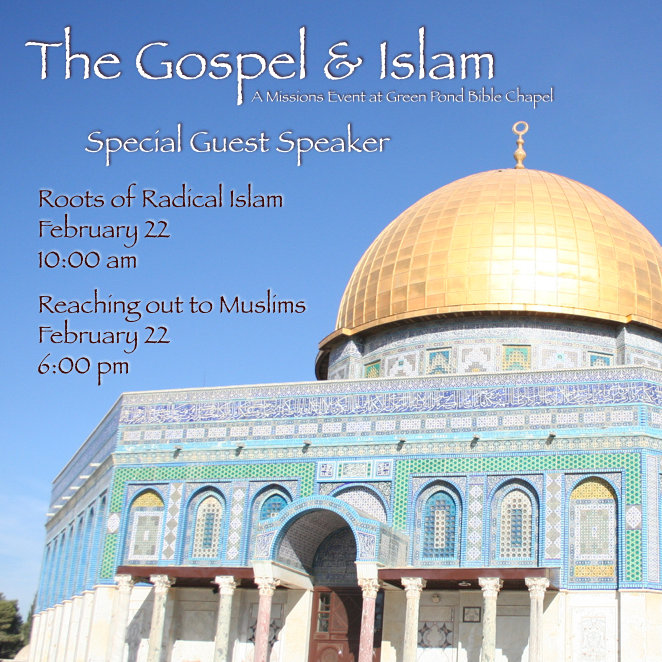
Don’t forget that tomorrow is the Gospel and Islam event @GPBCNJ. We have the privilege of hearing an experienced voice speak on the roots of radical Islam and reaching out to Muslims. Given the recent execution of 21 Coptic Christians by ISIS, these matters couldn’t be more important and timely. Tomorrow is your chance to ask an expert questions about Islam in general, Islamic fundamentalism, and the church in the Muslim world. You will not only be informed, you will be encourage to share the love of Christ with the Muslim world. I look forward to seeing you at 10 AM and 6 PM. Note—Should the weather cause problems in the morning, we will have both sessions in the evening.
 Making and Maturing