
Making and Maturing

Disciples of Jesus

  • Give Thanks

    “Give thanks to the LORD, for he is good. His faithful love endures forever.”

    -Psalm 136:1

    You might be familiar with this refrain from Psalm 136 as it is also found in 1 Chronicles 16:34, Psalms 106, 107, 118, and 136. It is a formula of thanksgiving and worship. These short sentences pack a big punch: they contain one command followed by two reasons to obey. As we enter into our culture’s season of thanksgiving, let me encourage you to let the structure of this chorus guide the way you give thanks.

    Give Thanks to God

    Notice that the command to give thanks identifies to whom we should give thanks: Yahweh, the God of Israel. This specificity means we should thank the God who is rather than anyone or no-one. We may be tempted to follow the influence of society in generically giving thanks without specifying the particular benevolent party. This is a byproduct of religious pluralism and the rejection of absolute truth; it doesn’t matter whom you thank, just be thankful. If there is no true deity then the exercise of giving thanks to a figment of our social imagination is at best a waste of energy and at worst self-deceiving.

    Likewise, giving thanks to an impersonal force (like the universe) is absurd because an impersonal force hasn’t chosen to give you anything. In fact, it is the intentionality and will of the Giver that make thanksgiving appropriate. He has chosen to act in accord with his character on our behalf, and thus he is worthy of thanksgiving. When we give thanks, let’s thank the God who actually is and who purposefully acts in time and space for our good.

    Give Thanks Because God Is Good

    The refrain goes on to identify two reasons we should thank the God of Israel. First, he is good. This means that he is not wicked, corrupt, or evil. God always acts out of the goodness of his character, and those acts include creation as well as redemption (see the rest of Psalm 136). God’s goodness is true even when he ordains that we go through hard times. Even in such times we can thank him because his goodness permeates and supersedes the short term difficulty of trials. He is not mischievous or malicious—he is good, all the time.

    Give Thanks Because God is Faithful/Loving/Merciful

    The second reason we should thank God is because of his faithful covenant love. This term—hesed—is notoriously difficult to translate. It refers to God’s gracious commitment to keep his covenant promises regardless of the failures of mankind. It’s a good word. We thank God not only because he’s good, but also because he acts in loving, merciful faithfulness forever. He is gracious, and that grace is seen most clearly in the cross of Jesus Christ and it will never run out. We may have failed, and others may have failed us, but God never fails. We have much to be thankful for, so let us give thanks to the Lord. He is good, and his faithful love endures forever.
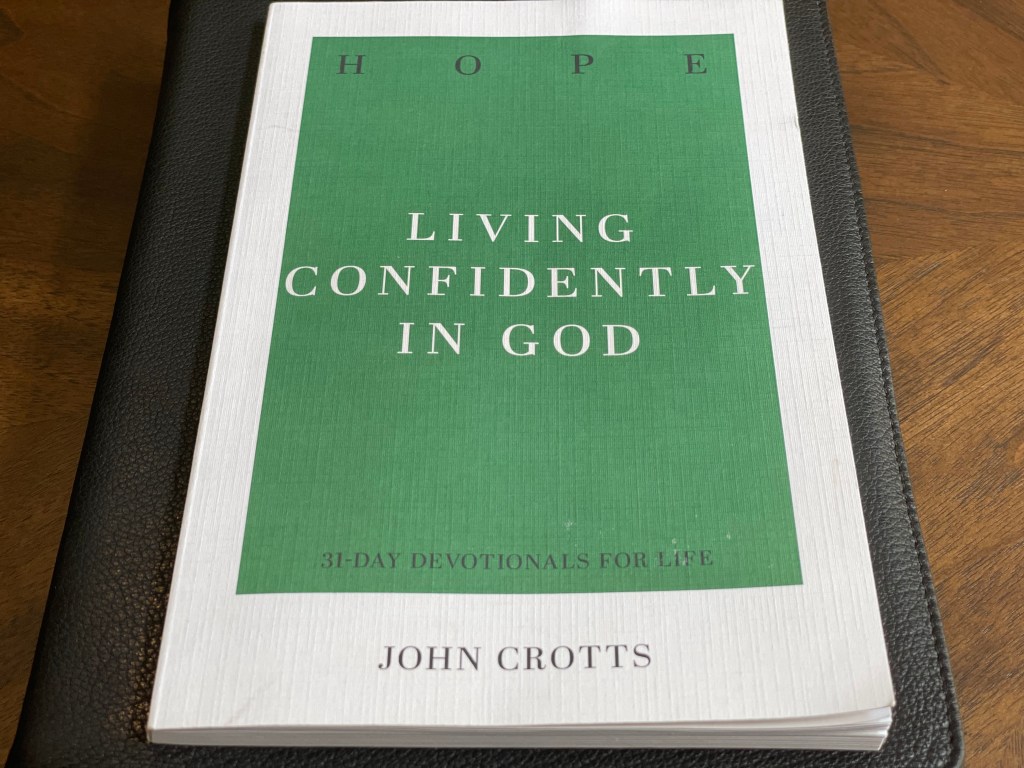
  • Book Review: “Hope: Living Confidently in God” by John Crotts

    “…he has called us to be born again to a living hope through the resurrection of Jesus Christ from the dead.”

    -1 Peter 1:3

    In the interest of recommending quality spiritual resources let me introduce you to a 31 day devotional by my friend John Crotts. Hope: Living Confidently in God is just what a devotional should be. John has helpfully curated 31 passages of Scripture that offer the Christian genuine hope in the midst of the real struggles we face in life. Here’s what you can expect to find in Hope:

    Scripture as the Basis of Hope

    John doesn’t offer platitudes or trite catch phrases. Instead, he grounds each devotion soundly in God’s Word. We are always tempted to be attracted to the new and novel, but what we need daily is neither. It’s only sure sustenance from God’s Word that gives us true hope.

    Refreshing Honesty

    In Hope you won’t find a Pollyanna naïveté about life. On the contrary, each devotion is informed by a realistic awareness of the daily challenges we face. John uses helpful examples drawn from his pastoral and life experience. In short, this devotional is authentic, and that authenticity contributes to its effectiveness. In “When Your Options Run Out” John writes,

    “Whatever situation you are facing, even if you feel like there is no way out, consider how your trial is a platform for God to display his power and love for you.” 

    General and Specific Devos

    My favorite feature of this devotional is the balance of general principles of hope anchored in God’s character and the gospel with circumstance-specific hope. You’ll find devos with titles such as “Jesus Has the Power and Heart to Help” and an entire section on how “God’s Character Sustains Hope.” You’ll also come to a section entitled “You Can Face Life’s Difficulties with Hope.” There John offers devos like “When You Feel Abandoned by God” and “When You Are Struggling with Sin.” I really enjoyed the one-two punch of the general and specific devotions.

    Lively illustrations and Practical Application

    As you read this devotional you’ll also find many illustrations and examples that make reading it a pleasure. These illustrations bring the concepts to life and help the reader envision practical application of the truths of God’s Word. Each devotion ends with a short encouragement to reflect and act. There John offers some ideas for further reflection/prayer and some specific ways to directly apply the passage to your life. 

    A good devotion is like a good tour guide, it points you to what is noteworthy without becoming the center of attention. If you’re looking for a solid and spiritually edifying devotional consider Hope: Loving Confidently in God by John Crotts.

  • Sacrifice Is Still a Thing

    “No one has greater love than this: to lay down his life for his friends.”

    -John 15:13

    As is always the case, the Olympics have brought with them high drama. One major story this year  for team USA has been gymnast Simon Biles and her decision to pull out of the women’s team competition and most of her individual events. She didn’t feel mentally ready to compete, and safety concerns alone warranted such a choice. Without knowledge of the specifics we can grant that she likely chose wisely.

    Many have favorably compared Biles’ decision to pull out with Kerri Strug’s performance while injured on the vault back in 1996 (remember how she landed an epic vault on one foot?). In fact, one commentator has opined that Strug was forced to do the vault by her coaches against her will and how such a thing should never be. In contrast, some argue that Biles put herself first and should be applauded for it. (For what it’s worth, Strug herself has encouraged Biles in her decision).

    This conversation has brought to light an interesting shift in our culture’s take on the Kerri Strug moment. In our highly individualistic and therapeutic environment, Strug’s vault increasingly does not compute. Why would she risk injury for something as antiquated as national pride? The consensus seems to be she should have put herself—her physical and emotional well being—first. 

    Every Olympian risks their well being to compete at the highest levels, but I think Strug’s vault is a powerful illustration of something we’re losing as a culture: the value of personal sacrifice for a cause greater than self. I cannot speak as to whether or not she was forced to do the vault while injured, but one way or another she chose to do it and did so for the sake of Team USA and her country. Because she put the many above herself, her vault wascourageous and heroic. 

    Strug’s vault is an iconic example of courage and bravery motivating someone to risk their well being for a greater cause. In John 15:13 Jesus himself defines love in terms of sacrifice. While sacrifice is not all that love is, sacrifice is a necessary component of love. In verse 12 Jesus commands us to love one another as he loved us—this means with sacrificial love.

    In the church we must insist on holding sacrificial love high. The bride of Christ is the greater cause, and we are called by Jesus to sacrificially serve each other for her greater good. This calling runs directly contrary to our cultural focus on individualism. 

    Don’t get me wrong, I think Biles’ decision was probably the right one. I would argue that she put her team first and therefore her decision is another form of sacrifice for a greater cause. For me it’s not a question of Strug vs. Biles. Rather, it’s a question of self vs. the greater good. When it’s our turn to sacrifice, don’t discount the fact that true love is seen in sacrifice for the sake of others. It’s what Jesus has done for us, and examples of it are increasingly rare.

  • Be True to Yourself?

    “Be true to yourself.” 

    -Everyone

    This cultural gospel is so common it doesn’t strike us as odd. Put simply, BTTY asserts that we only find meaning internally, when we are acting in ways consistent with what we think and want and how we feel. 

    BTTY sounds healthy, but it’s not. If we accept this premise we will find disappointment and bankruptcy, not satisfaction and meaning. One increasingly difficult truth to embrace today is as human beings we were created to find our satisfaction outside of ourselves.

    BTTY has an authority problem—no one has the right to tell you how to live. 

    In The Rise and Triumph of the Modern Self Carl Trueman notes how 19th century Romantic poet Percy Shelley’s attack on organized religion and marriage was based on a fundamental distrust of authority. He explains how regarding both religion and marriage, “the individual has to acknowledge the existence of an external authority beyond that of immediate, personal desires.” 

    We don’t like authority (maybe we never have). But this anti-authority ethic crashes headfirst into what God reveals in the Bible. For example, the Apostle Paul writes of enemies of Christ in Philippians 3:19,

    “Their end is destruction; their god is their stomach; their glory is in their shame; and they are focused on earthly things.”

    Not much BTTY there.

    When we believe our appetites are the true guide to our authentic selves then they become our god. The inevitable result is we glory in what we should be ashamed of, and we necessarily live with an earthly rather than heavenly perspective. We’ve turned appetites into ends rather than means. 

    Appetites themselves are neither good nor evil. When we eat, do we eat with thanksgiving for God’s provision of our needs or do we eat looking to food as our ultimate satisfier? Our hunger is morally neutral; what we do with that hunger is not. The same applies to desires of any kind—financial, emotional, sexual, etc.

    The alternative to BTTY is to seek meaning outside of ourselves in Jesus Christ. But how does faith in and submission to God—our infinite, external authority—satisfy rather than stifle us as human beings?

    • Faith anchors our purpose in the Creator-creation distinction. We have a purpose than transcends our abilities, knowledge, moods, and circumstances. Generating purpose and satisfaction is not our burden.  
    • Faith anchors our purpose in a loving redeemer. In Jesus we find a savior who sees us in our brokenness, loves us, and has acted to rescue and reform us. We need not seek love from ourselves or society, we have perfect love in Christ.
    • Faith anchors our purpose in God’s glory. When we value what is truly and infinitely valuable we are equipped to discern how to navigate the twists and turns of our lives.

    Maybe the best way to BTTY is to admit that left to ourselves we have no ultimate meaning. BTTY by finding true satisfaction outside of yourself in Jesus Christ.

  • The Lord Is Near the Brokenhearted

    “The LORD is near the brokenhearted; he saves those crushed in spirit.”

    -Psalm 34:18

    Hearts break for many reasons. In American English we most often use brokenhearted imagery to refer to sadness that results from a romantic failure. But the image itself comes the Old Testament where it applies generally to being beat up by circumstances. 

    Hearts break because of tragic deaths, financial disasters, sicknesses, family conflicts, trouble with friends, or myriads of other reasons. The fact is that brokenhearted-ness is unavoidable living in a world stained by sin. No matter how hard we try to sugar coat it or avoid it, some days our hearts will break with grief and hurt.

    Which is exactly why we need verses like Psalm 34:18. In this Psalm David reflects on a time of extreme need when he was on the run. Friends had turned on him, and he had little hope of success or even survival. Yet on the run, hiding from enemies amongst other enemies, David discovered a theological gem: the Lord is near to the brokenhearted. This is another way of saying that God cares for those with broken hearts in a special way. 

    He is not far from the hurting, but he is near. Not only that, he saves those whose spirit is crushed. He is the rescuer—the redeemer. Our circumstances may not offer us hope. Certainly we cannot rescue ourselves. But in the midst of being brokenhearted, God says to us, “I will rescue you.”

    It is no wonder, then, that in Isaiah 61:1 we read of the Messiah, 

    “The Spirit of the Lord GOD is on me, 
    because the LORD has anointed me
    to bring good news to the poor.
    He has sent me to heal the brokenhearted…”

    Jesus’s ministry is the direct cause of hope for all whose hearts are broken because he solved the root cause of all broken hearts: sin. Whatever is crushing us today will not last. Sin and death have been defeated, and thus, even with tears in our eyes, we can move forward in faith. He heals the brokenhearted by offering eternal peace and rest. In the meantime when our hearts break, let us remember that the Lord is near the brokenhearted, and he saves those crushed in spirit.

    “Jesus, then, undertakes the cause of the troubled. He was a mourner all his days, and therefore he is very tender towards mourners.”

    -C.H. Spurgeon