Making and Maturing

Disciples of Jesus

  • Give Thanks? This Year?

    “For we do not have an enduring city here; instead, we seek the one to come. Therefore, through him let us continually offer up to God a sacrifice of praise, that is, the fruit of lips that confess his name.” 

    -Hebrews 13:14-15

    Giving thanks is hard during difficult circumstances. We know this, even though our own current difficulties admittedly pale in comparison to those in other places and times. Still, 2020 has been a difficult year. How do we give thanks in times like these? 

    The dynamic of praise in poor times is a distinctive of Christianity. As we read in the book of Hebrews we find out that some in the original recipients had been imprisoned, some mocked, and some had their possessions confiscated (Heb. 10:32-34). They had not yet suffered martyrdom, but that didn’t mean it wasn’t coming (Heb. 12:4). They were steadily losing face in the eyes of their neighbors, coworkers, and family because of their faith in Jesus.  Things were likely to get worse.

    So why should they continually praise or give thanks to God? Why should we? We find some compelling reasons in the immediate context of verse 15:

    1. Praise God because no amount of shame or suffering can undo our sanctification by Jesus

    One reason we are able to continue to praise God is because Jesus was crucified “outside the camp”—“Therefore, Jesus also suffered outside the gate, so that he might sanctify the people by his own blood” (Heb. 13:12). This imagery focuses on rejection and shame. Being outside the camp meant being shamed and unclean, but Jesus bore that shame to make us holy. 

    2. Praise God because Jesus redeems us despite rejection by the world. The author of Hebrews shockingly encourages his readers, “Let us then go to him outside the camp, bearing his disgrace” (Heb. 13:13). He urges us to willingly follow Christ potentially out of the camp of  approval by our friends and neighbors. Being shamed by a segment of our culture is no reason to complain. To bear his shame is not only possible, it is necessary. But it is not defeat. We’re safe outside the camp because that’s where we’re with Christ. 

    3. Praise God because this isn’t our home. The author of Hebrews reminds us we do not have an enduring city here, but “we seek the one to come” (Heb. 13:14). We can endure marginalization or suffering because Jesus suffered outside the camp and was victorious. We look to the heavenly Jerusalem for encouragement, and that is an enduring city.  It’s no fading promise; it’s the eternal city. Note that our reason for continued praise is not hope that our culture will come around. We need not seek satisfaction or vindication in our earthly cities, or be robbed of our praise when they fail.

    In light of this faith-driven eschatological mindset, we can give thanks in terrible times. We can continually offer praise in spite of less than ideal circumstances or even tragic ones. Our great High Priest made the sacrifice, and he is the same yesterday, today, and forever. 

    Reflecting on this concluding theme of praise in Hebrews, F. F. Bruce said, 

    “So in a day when everything that can be shaken is being shaken before our eyes and even beneath our feet, let us in our turn give thanks for the unshakable kingdom which we have inherited, which endures forever when everything else to which men and women may pin their hopes disappears and leaves not a wrack behind.”

    It seems like a lot of things are shaking right now. Outside the camp we have a bullet-proof, recession-proof, pandemic-proof, election-proof, death-proof basis for continual thanksgiving and praise: Jesus’s sacrifice on our behalf. Let’s give thanks looking to the enduring city to come.


  • Responding to 2020 (with help from John Owen)

    2020 has been… disappointing. Some days I would say discouraging, or exhausting, or even infuriating. On the whole, it certainly hasn’t been the year we expected. It has come with great loss on many fronts—loss of life, loss of unity, loss of freedoms, and loss of trust.

    I would agree with many when I say it’s been difficult to know exactly how to respond. So many days I’ve wanted to fast forward to 2021. But my friend John Owen has encouraged me to reinterpret 2020.

    Owen knew a thing or two about disappointment. He lived during the failed English Protestant attempt at a reformed English republic. It was a spectacular failure that cost Owen his career and almost his life. After the restoration of the monarchy in 1660 several of Owen’s friends were executed and their corpses displayed publicly for years.

    Owen spent 24 years sifting through the ashes of his ministry, personal, career, and political aspirations. Circumstances did not improve during his lifetime. As he described the situation from his viewpoint in 1684 he said,

    “All things in almost all nations are filled with confusions, disorders, dangers, distresses, and troubles…distress of nations, with perplexity, men’s hearts failing them for fear, and looking after those things which are coming on the earth.”

    He might as well have been describing 2020.

    Through it all he buried ten (10!) children and his first wife. He was forced to abandon his career in academia. All he had left was his investment in small, independent church plants that had no great prospects for success.

    One of the last letters he wrote was to a friend in one of those churches. Owen knew he would soon be at peace with Jesus, and he felt that the situation for the church in England would deteriorate further. Too weak to write, he dictated the letter to his second wife. What was his advice to those ordained to carry on in such difficult times?

    “Live and pray and hope and wait patiently and do not despair.”

    He saw the trouble around him, but he lifted his gaze to the glory of God in the face of Jesus. Biographer Crawford Gibben summarized the moment well, “After a lifetime of work that most would have deemed a failure, and after failed eschatological hopes, Owen was waiting for Jesus.”

    Perhaps Owen’s change in focus from the grandeur of Oxford and Parliament to the church was not a downgrade, but an upgrade. Perhaps the failures and disappointment he experienced freed him from hoping in this world and allowed him to focus on what will last forever. My friend John Owen has encouraged me, and perhaps he can encourage you too: “Live and pray and hope and wait patiently and do not despair.”

    PS- Crawford Gribben has written a great intro to John Owen. It’s brief, accessible, and has some great devotional moments. If you have more time you could always turn to Owen’s massive 7 volume commentary on Hebrews.

  • The Revolution Is Already Here

    “In the days of those kings, the God of the heavens will set up a kingdom that will never be destroyed, and this kingdom will not be left to another people. It will crush all these kingdoms and bring them to an end, but will itself endure forever.”

    -Daniel 2:44

    Every election cycle we face the prospect of a new wave—a revolution. Now things are going to change. To be sure, sometimes elections and changes in government do result in large-scale changes to a society. I’m thinking here of the British colonies in North America in the 1770s or France in the late 1780s. But even those revolutions failed to ultimately bring about lasting peace. 

    Not to rain on your Election Day/week parade, but the revolution we need started 2,000 years ago and is still going on. I’m talking about the establishment of kingdom of God—the Church. Jesus announced in Mark 1:15 that he had ushered in the new age, the age in which the kingdom of God was now at hand, 

    “The time is fulfilled, and the kingdom of God has come near. Repent and believe the good news!” 

    This kingdom is different than other kingdoms.  In Daniel 2 God gave the Babylonian king Nebuchadnezzar a dream of what his kingdom is like compared to the massive Babylonian juggernaut of that day. In the dream earthly geopolitical kingdoms were represented by massive statues made of different metals. This week especially the specifics are worth noting:

    “Then the iron, the fired clay, the bronze, the silver, and the gold were shattered and became like chaff from the summer threshing floors. The wind carried them away, and not a trace of them could be found. But the stone that struck the statue became a great mountain and filled the whole earth.”

    -Daniel 2:35, emphasis mine
    • Earthly kingdoms aren’t that great. In Nebuchadnezzar’s dream the massive metal statues were shattered by a stone and were blown away like dust in the wind. At their peak worldwide empires seem like a big deal, but they won’t last. In fact, they will be replaced by a greater kingdom.
    • The kingdom of God is greater than any kingdom.  The stone that breaks the statues is not cut by a human hand but comes from heaven. The prophet Daniel clarifies that this is God’s kingdom, and it will crush all competition. The revolutionary work of Jesus in building the Church is a bigger deal, and it  is a movement that will ultimately displace all other governments.  
    • The growth of God’s kingdom is unstoppable. In his dream Nebuchadnezzar that the stone that destroyed earthly kingdoms grow into a mountain that “filled the whole earth.” The idea is that the stone will grow and grow and grow until it encompasses all. In the midst of political and social upheaval it is good to know that the kingdom of God will continue to grow and no government or movement can stop it.
    • God’s kingdom will last forever. Crucially, Daniel explains that the kingdom of God “will itself endure forever.” Not only will the Church keep growing, it will last throughout all eternity. It’s not going anywhere, ever. Why? Because it is built by God. The Church is eternal because it is God’s work, not carved by human hands. 

    God’s kingdom is revolutionary because it is made up of sinners turned into saints by faith in Jesus Christ. It is a revolution of loves, where love for God and love for others replaces any other rivals. It is a revolution of morals and behavior, where holiness replaces immorality and selfishness. It is a revolution of purpose, where living for the glory of God overrides any other purpose. It is revolutionary because the Spirit of God guarantees it will succeed. And it’s a revolution that will outlast any election cycle or empire.

    In light of these truths, here are a few election week takeaways:

    • Check any party-based passion. While a political party can be helpful in clarifying stances on particular issues, they are no replacement for the Church. Sometimes we’re too passionate about our party affiliation.
    • Sleep soundly Tuesday night. While most of our nation and many in the world will watch with anxiety as election results come in, feel free to go to bed. Whatever the results are, God’s kingdom movement has not changed.
    • Watch your tone on Wednesday. It’s possible we’ll know the outcome of the election on Wednesday. If we do, be careful how you respond. Anger and bitterness are a threat should your candidate lose, and pride and boasting are a threat should your candidate win. Either way, the stone continues to grow into a mountain. So we are freed to respond to the election results with faith in God and peace rather than sinful ecstasy or panic.

    These may be tumultuous times, but the mission of the Church hasn’t changed. Let’s glorify God as we make and mature disciples no matter what happens on Tuesday.

  • Pray for Our Nation

    First of all, then, I urge that petitions, prayers, intercessions, and thanksgivings be made for everyone, for kings and all those who are in authority, so that we may lead a tranquil and quiet life in all godliness and dignity. This is good, and it pleases God our Savior, who wants everyone to be saved and to come to the knowledge of the truth.

    -1 Timothy 2:1-4

    We need to pray for our nation. We always need to pray for our nation, but in an election cycle our need for prayer is more obvious—especially in the year 2020. We are facing the outbreak of COVID-19 and a highly contentious response at both the State and Federal levels, riots due to social injustice and ethnic division, massive polarization over political views and court appointments, and the normal stuff like taxes, the job market, international trade, etc. Governing well has never been easy, but in 2020 it’s virtually impossible.

    Despite those obvious needs for prayer, the apostle Paul gives us two fundamental and spiritual reasons for praying for our government/ culture. These reasons remind us what’s best about a functional society, and why it’s in our best interest to live in one. 

    1.  Pray for our nation so that we may live out God’s calling in peace.  In 1 Timothy 2:1-2 Paul calls us to pray for our leaders ““…so that we may lead a tranquil and quiet life in all godliness and dignity.” Good government facilitates a peaceful environment in which we can live out God’s calling for us—loving him with all that we are and loving others as much as ourselves.  

    2. Pray for our nation so that we may work at disciple-making.  In 1 Timothy 2:3-4 Paul emphasizes that a peaceful society is good also because living out God’s calling will result in the making of disciples of Jesus. He reminds us that God “wants everyone to be saved and to come to the knowledge of the truth.” A peaceful, well-ordered society allows for the gospel to spread through the freedom of Christians to live for God’s glory.

    3. This doesn’t mean God doesn’t use turbulent times for our benefit.  A peaceful society is the ideal for faith-driven living and disciple making. That doesn’t mean that trials and upheaval are bad for the church. In many other passages in the Bible God makes it clear that trials are good for spiritual health of Christians. Even so, it is good for us to live in peaceful communities and therefore it is good for us to pray for our government.

    I invite you to join us in praying for our nation over the next four weeks. Let’s humble ourselves before the throne of God and beg him to intercede for his glory and our greater good.

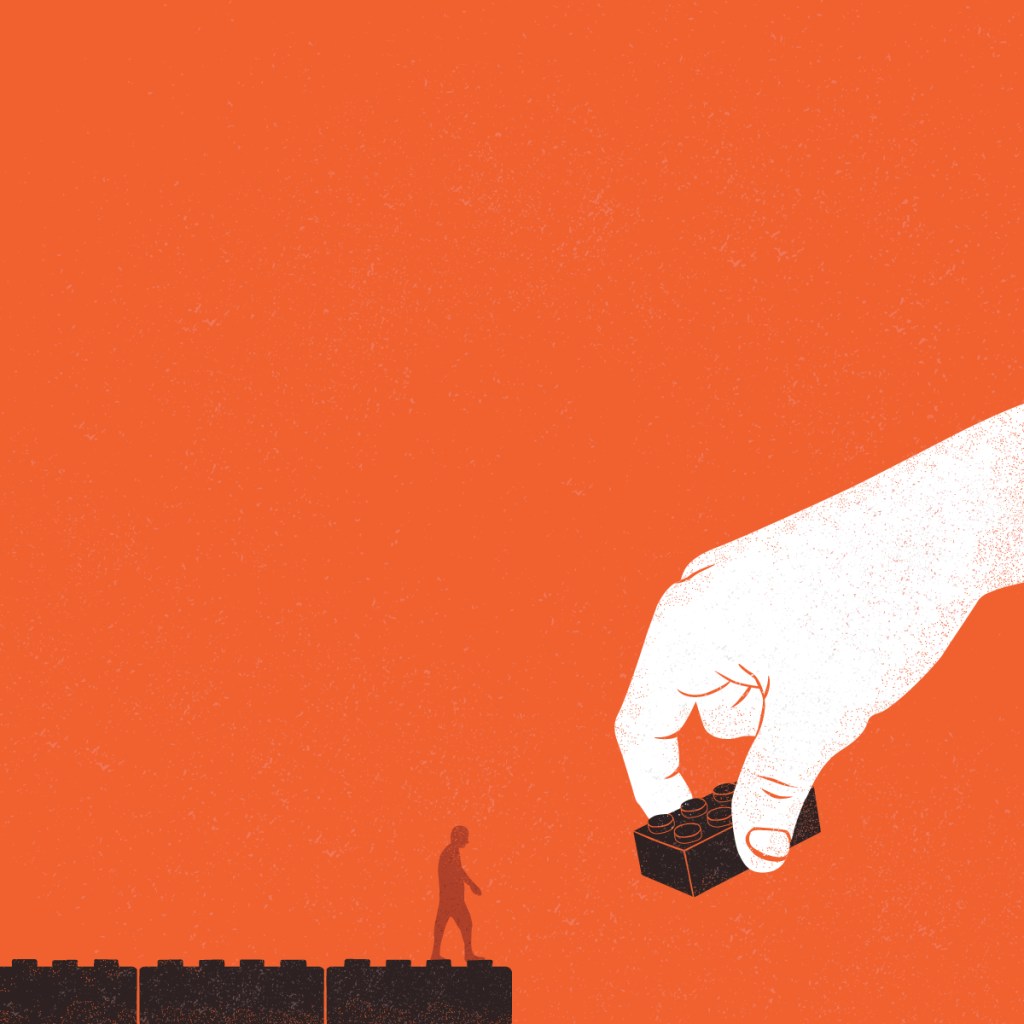
  • Not Made with Hands

     “We heard him say, ‘I will destroy this temple made with human hands, and in three days I will build another not made by hands.’”

    -Mark 14:58

    When Jesus was on trial before the Sanhedrin, he was accused of saying he would destroy the physical temple in Jerusalem and build another temple “not made by hands.”  This was a distortion of what Jesus actually said.  He did prophesy of the temple’s destruction, which happened in AD 70.  He also prophesied that when he was killed he would rebuild “this temple” in three days, referring to his resurrection (John 2:19-21).

    What the false accuser actually got right was the second part—that he said he would build another kind of temple, a temple “not made by hands.”  That verbiage refers to a spiritual work in contrast to merely a wood and stone building. 

    The phrase “not made by hands” here means “not made by human hands.”  Jesus’s death and resurrection was the building of a spiritual work that no human could do.  This is confirmed for us in Hebrews 8: 2 were Jesus is described as:

    “…a minister of the sanctuary and the true tabernacle that was set up by the Lord and not man.”

    Jesus’s work is not an earthly work done by men.  It is a heavenly work with earthly effects.  We need this reminder because we are easily distracted by earthly work.  The construction of buildings and making of companies and the pursuit of popularity and the amassing of riches are temporary pursuits.  They are not the end all, be all of our existence.  They cannot satisfy and will not last, because they are made by human hands.

    But Jesus’ work is not made by hands.  His work stands forever.  His permanent, heavenly work impacts how we go about our earthly pursuits.  Because his work is not made with hands…

    1. We can focus on Jesus’s purposes when we’re tempted to be consumed by earthly concerns.
    2. We can be assured of our forgiveness when we fail.
    3. We can move forward ministering the gospel with confidence despite hostility in our culture.
    4. We can endure massive changes in society without fear that Jesus’s work will fail.
    5. We can rely on Jesus in faith when we face personal trials.
    6. We can risk faith-driven obedience when we’re not confident in ourselves.
    7. We can rest with his peace even in the darkest of times.

    Why?  Because his temple isn’t made with human hands.  It’s built to last, and it’s built to be shared with us.  So we’re freed from fear that we may confidently focus on Jesus’s purpose for us. This is why the apostle Paul says,

    “For we know that if our earthly tent we live in is destroyed, we have a building from God, an eternal dwelling in the heavens, not made with hands.”

    -2 Cor. 5:1