Making and Maturing

Disciples of Jesus

  • Problem People in Hebrews 11

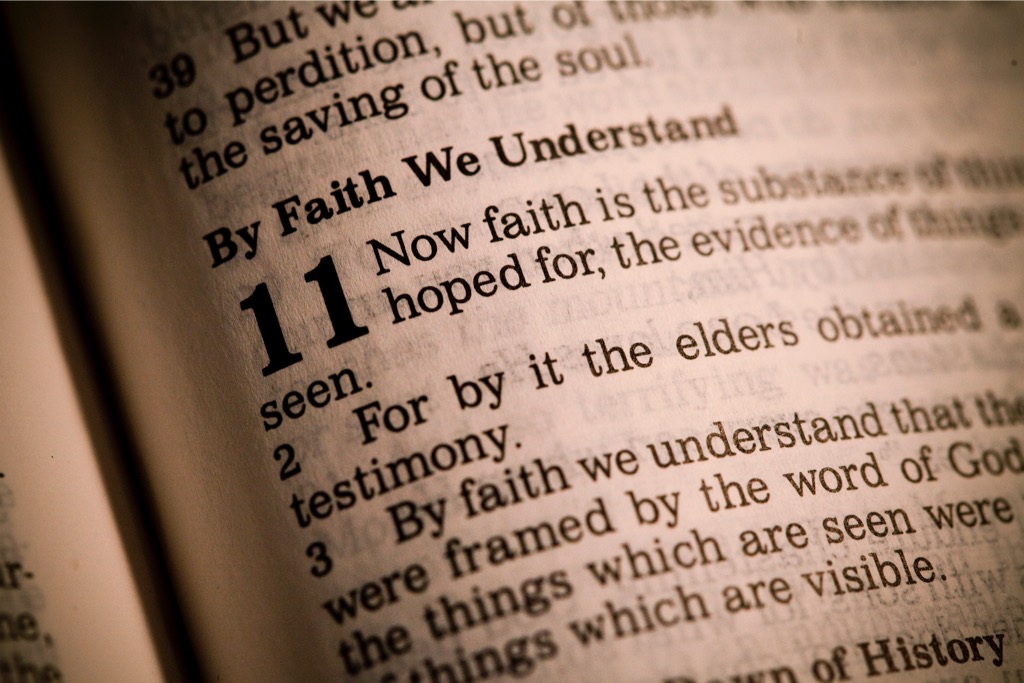
    There’s a problem with the “Hall of Faith” (Christians often refer to Hebrews 11 as the Hall of Faith, as opposed to a “Hall of Fame,” more on that below). The problem is in Hebrews 11:32-34,

    And what more shall I say? For time would fail me to tell of Gideon, Barak, Samson, Jephthah, of David and Samuel and the prophets— who through faith conquered kingdoms, enforced justice, obtained promises, stopped the mouths of lions, quenched the power of fire, escaped the edge of the sword, were made strong out of weakness, became mighty in war, put foreign armies to flight.

    The problem is Gideon, Barak, Samson, and Jephthah. Is David a Hall of Faith guy? No doubt. One major failure, but God’s grace abounds, right? What about Samuel? This guy was a faith machine from a young age. You try rebuking the retired High Priest about his parenting skills when your voice hasn’t changed yet (1 Samuel 3:15-18). How about the prophets? Clearly Daniel is in view, as well as others, and they definitely pass muster.

    But have you read Judges lately? Gideon had precisely 1.5 faith moments in Judges. He gets partial credit for tearing down the altar to Baal, but loses points for doing it at night (6:25-27). He was finally convinced to trust God by a divinely inspired albeit bizarre Midianite dream, and did so for the duration of the “battle.” In the aftermath, however, Gideon quickly lost sight of God, and ends up setting up another idol.

    How about Barak? Barak scores a little better than Gideon, but he still hesitated to believe that God would use him to lead Israel to victory. He practically had to be pushed down Mt. Tabor to go fight, and a housewife took his privilege of killing the enemy general, Sisera.

    What about Samson, the undisputed UFC champion of the OT? Samson expresses exactly zero faith in the Judges narrative. He’s too busy chasing girls. Even at the dramatic conclusion of his life, his prayer to God is motivated by a desire for personal revenge against the Philistines.

    And then there’s Jephthah, who, despite what you may have been told, most certainly sacrificed his daughter in a Canaanite ritual as “payment” for God’s giving Israel victory.

    The author of Hebrews commends these men to us, but why? They are not role models in the way they lived their lives. As far as the Biblical record goes, they only had fleeting moments of faith. So why commend them? Because Hebrews 11 isn’t about what they did; it’s about what God did.

    How does Gideon’s “army” defeat an innumerable Midianite host? How does Barak’s infantry succeed against Jabin’s iron chariots? How does Jephthah the social outcast provide victory over the Ammonites? How does Samson, one man, provide victory for Israel over the Philistines?

    They didn’t. God did. Even if just for a moment, these men followed God’s lead, believed his promises, and acted in faith. Reflecting on the awkwardness of their presence in Hebrews 11, John Calvin said,

    Therefore, the apostle attributes their every praiseworthy deed to faith, even though there was not one of them whose faith was not lame!

    The Hall of Faith isn’t at all like a Hall of Fame. Consider the Pro Football Hall of Fame: players are inducted by a selection committee that considers their accomplishments as a player. But in Hebrews 11, it’s not the individuals’ acts that are in view, but rather their faith in God who acts for them.

    What should we take away from the presence of these questionable characters in Hebrews 11?

    1. Their presence does not endorse a sinful lifestyle. We shouldn’t think that Gideon’s anxiety or Samson’s lust somehow provides a justification for our own. It doesn’t.
    2. Their presence should remind us that faith is about God, not us. Perhaps today each person listed in Hebrews 11 would say, “It’s not about me, it’s about him.” Let’s not be naming ministries after ourselves.
    3. Their presence should motivate us to live by faith. This is what the author of Hebrews is after- casting off sinful entanglements and running the race God has for us by faith in him. Why should we attempt to serve God in remarkable ways? Because we believe he is who he says he is.
    4. Their presence reminds us that God is pleased to use common people for his glory. We can all relate to Gideon, Jephthah, Barak, and Samson on given days. God used them in spite of their significant limitations.

    Again, Calvin has good insight here:

    …the wrongs which burden us should neither dishearten us nor break us down, provided only that we follow our calling by faith.

    In the same way, God calls us to great faith in him. There is hope for us, not because of who we are, but because of who God is. When we think about Gideon, Barak, Jephthah, and Samson, we might wonder what would have happened had they trusted God more. But this doesn’t go far enough. The better question is, what would happen if we trusted God more?


  • Gender Problems

    We have gender problems. If you doubt that, I could tell you about the elementary school teacher who recently had a girl decide she was now a boy. She and her new girlfriend have presented a new legal minefield for their teacher, never mind the challenges for healthy social development and learning.

    Or we could remember that last year ESPN gave transgender person Kaitlyn Jenner, formerly Bruce, the Arthur Ashe Courage award. As a culture, we are celebrating the “bravery” of those who dare to reject their God-given gender.

    Or we could look at the new law New York City recently passed relating to transgender use of bathrooms. According to the Associated Press, the law states “that transgender people can’t be denied access to the restroom or locker room where their gender identity belongs, at their discretion.” (Contrast that with the city of Houston, where sanity has prevailed for the moment).

    Choosing one’s “gender identity” has been thrust upon American society as a civil right. Note carefully what this means. In the new humanity, gender is now negotiable. Born a man? Should’ve been a woman? No problem. Just change your gender.

    This worldview makes perfect sense in a Creator-less universe. But those who believe God exists have a problem. We find it in Psalm 139.

    I praise you, for I am fearfully and wonderfully made.  Wonderful are your works; my soul knows it very well.

    -Psalm 139:14

    Our gender confusion disagrees with this moment of worship. When we believe we have been created with the wrong gender, we are saying, “I am not wonderfully made.” Implicitly, dissatisfaction with our gender is dissatisfaction with God as creator.

    Everyone struggles with discontentment regarding how God has made us. But gender rebellion escalates discontentment to idolatry. If God exists, then he has creative rights over what he has created. To claim those rights for ourselves violates God’s right as creator (AKA idolatry). The gender issues we are facing are just another example of humanity trying to usurp God’s authority.

    But our gender problems aren’t limited to transgender issues. Every time there’s tension between husband and wife, gender issues are in play. Every time a man abuses a woman, gender issues are involved. Every time a woman wants the role of a man, gender issues are involved. The truth is, gender problems go all the way back to Eden.

    At Green Pond Bible Chapel, we have proposed an addition to our doctrinal statement that deals explicitly with Gender, Marriage, and Sexuality. We will be addressing key Biblical passages from the addition in the coming weeks on Sunday mornings, beginning January 3rd. We want to proclaim God’s truth with compassion and conviction. In a world that seems to be growing increasingly dark, we want to hold forward the light of the gospel of Jesus Christ.

    Yes, we’ve made a mess of gender. But since Genesis 3 God has been cleaning up our mess. He is our only hope for redemption and sanity regarding gender. I invite you to come and consider Gender, Marriage, and Sexuality from a Biblical perspective with us.

  • Merry Christmas!  Now Back to the Sheep.

    Merry Christmas to all! I sincerely hope that your Christmas celebration was full of worship, joy, and inspiration. For many of us, Christmas is a highlight of our year when we focus especially on the incarnation of Jesus the Messiah. We celebrate that God’s Son took the form of a servant and walked among us. We rejoice at the fulfillment of centuries of prophecies that God would send a savior for mankind. Awesome!

    And then comes “Boxing Day”- the obscure British holiday that is December 26th. It’s the day after Christmas, also known as “Shopping Purgatory Day.” It’s a day set aside so that we can return gifts people gave us and get what we really wanted. Ouch.

    I bring up that awkward juxtaposition of spiritual focus and materialism to make a point: often our Christmas focus is a spiritual flash in the pan. Christmas can be a Jesus-centered moment in the midst of an otherwise not very Jesus-centered life. Christmas is a great cultural opportunity to focus on Jesus, but it’s not enough. A real encounter with the Son of God should leave a lasting impact. It should result in life change. But often it doesn’t.

    The battle to worship Jesus every day is not new. I think it’s always been a challenge to translate a spiritually climactic moment into daily living. What about those who were the first to encounter Jesus on earth?

    Consider Mary. After experiencing the miraculous birth of the Messiah, and the visit of some random worshipping shepherds, Luke tells us that “Mary treasured up all these things, pondering them in her heart” (Luke 2:19). Luke is describing reflection. It is not a stretch to suggest that Mary didn’t want to forget what had happened.

    What she had experienced was so remarkable, she never wanted to lose sight of it. But instinctively she knew she had to purpose to not let the moment just pass. Why? Because she would be busy changing diapers and doing laundry and cooking and shopping and momming. Life was about to happen.

    Do you treasure your relationship with Jesus? Do you take time to reflect on who he is, what he has done, and why it matters to you? Have you made it a point to anchor those moments in your soul? To insist on remembering?

    Consider Joseph. Joseph had already experienced a great change of heart due to God’s intervention (Matthew 1:20, 24-25). Months of waiting had verified that God’s Word to him was true. His faith was not misplaced. Perhaps the circumstances of Jesus’ birth, and the remarkable visits of the Shepherds and Magi, had reassured him that his faith was not in vain.

    But he still had to register for the census. He temporarily relocated his young family to Bethlehem, and then they had to flee the country as refugees to Egypt (Matthew 2:14). Refugees! I am sure that it was very difficult to walk by faith while running for their lives. In the midst of all this, Joseph was responsible to provide. He had to deal with the practical dad issues of working to provide for the family, but he also had to deal with the fact that the king wanted his son dead. No one said it would be easy.

    Do you let the stresses of work or politics or family drown out your faith? Do you let fear and anxiety distract you from hope and faith in Jesus? It’s never easy.

    Consider the Shepherds. These guys were the first to get the memo from God that the Savior had been born. They left their sheep and found Jesus just as the angel had said. They worshipped. Then they went and spread the word about what they had experienced. What a moment! Now what?

    Now they had to get back to their sheep. The men who were the first outside the family to meet the Messiah had to deal with, you know, shepherding things. Like chasing sheep. Feeding sheep. Moving sheep. Chasing sheep again. Etc.

    Do you remember Jesus in the mundane moments of your life? At work or at school? When you’re stuck in an endless cycle of traffic or laundry? Chasing sheep can suck the spiritual focus right out of you.

    Consider the Magi. These astrologers for some foreign royalty had by the sheer grace of God seen the sign of a new star and deduced that the new King of the Jews had been born. We don’t know how all that worked out, but it did. They came, they offered their gifts, they dodged the bullet that was Herod the Great, and they went home (Matthew 2:11-12).

    To what? To a pagan religious context. Surely what they experienced would mean changes for them theologically. But not just theologically, because their theology was their livelihood. Did they lose their jobs? Did they preach the gospel to their king? Did they impact their culture? Were they imprisoned? We don’t know. One way or another, they went home changed men.

    This year maybe you need to insist on Christmas not just being Christmas. Maybe you need to insist on being changed by Jesus. Maybe you need to reflect on the significance of the gospel in your life. Maybe you need to resolve that you will worship all year. Maybe you need to get serious about reading your Bible and staying active in your church. Whatever you do, don’t let Christmas be just a moment.

    Now get back to those sheep.

  • Christmas Abide Reading

    The best way to keep the worship of Jesus at the center of your family this holiday season is to read the Bible (just ask Linus). Yes, there are so many distractions. What can we do? We can encourage one another to read God’s Word.

    To help keep our eye on the prize, we’ve updated our Abide reading schedule for the holidays.

    We’ve planned readings that accompany the Sunday morning series “The King Has Come: Prophesies of Jesus’ Advent.” We will look at prophecies in Genesis, Isaiah, and Micah that all find their fulfillment in Jesus’ coming.

    You can access the Abide reading schedule on our new app (for android too!) or online here.

    Also, if you’re rusty on how the Abide reading plan works, you can freshen up here.

    Let’s worship the King together!

  • The Abide Bible Reading Plan

    The Abide Bible Reading Plan is designed for everyday Christians who are busy with work, commuting, chasing kids, going to school, and everything else. The Abide plan can help you stay in God’s Word in the midst of the craziness of life. It does so in 4 key ways:

    1. The Abide plan enhances grasping the message of a passage of Scripture by keeping the context in focus. Every week you zoom out and re-orient yourself to part of the Bible you are reading.
    2. The Abide plan emphasizes saturation in God’s Word. Rather than racing through books of the Bible, the Abide plan facilitates reflection on God’s Word.
    3. The Abide plan is flexible. It is designed for adaptation to the ebbs and flows of daily life. No more guilt or frustration at falling behind!
    4. The Abide plan is built for coordination with preaching or Bible study schedules. It’s more than just reading passages ahead of time. The Abide plan enables you to soak up the message of a passage and get more out of a sermon/Bible study.

    How does the Abide Bible Reading Plan work?

    The Abide Bible Reading Plan is a two step reading plan based on weeks rather than days. Every week you will read two different parts of the Bible: a contextual passage and a focus passage.

    Step 1 (one day):

    At the start of the week, read the contextual passage. Using the book of Philippians as an example, the entire book (4 chapters) is the contextual passage. That reading should take between 10-20 minutes.

    Step 2 (multiple days):

    The rest of the week, read the focus passage on a daily basis. This passage will be shorter, usually 10-30 verses depending on the genre. The first focus passage for Philippians is Philippians 1:1-11. As you continue to read the focus passage, you will become more familiar with it, making new observations and insights each day. If you miss a day, no big deal. If you start a day late, no big deal.

    Moving On:

    The next week you start by reading the contextual passage again (Philippians 1-4), and then move on to the next focus passage: Philippians 1:12-26. By the end of Philippians you will have read the book in its entirety 10 times over 9 weeks. You will probably have unintentionally memorized verses, and you will have a firm grasp of the message of the book. Furthermore, you will naturally understand each focus passage in light of the context of the book.

    As an added bonus, if you do the Abide Bible Reading Plan with a group (an entire congregation, a small group, a Bible study, a family, a couple, etc.), you will have a common ground of Scripture reading to discuss and share.